Dogs in Ancient Civilizations: What Archaeology Reveals About Egypt, Rome, Greece and Beyond
Dogs in ancient civilizations guarded homes, joined hunts, appeared in sacred rituals, and sometimes received deeply personal tributes.

Picture a dog standing at the entrance to a Roman house. Its job is familiar: warn strangers away. Now picture another dog, made of bronze, hidden beneath a doorway in ancient Mesopotamia. That animal had a different assignment. It was supposed to protect the building from unseen danger.
Across the ancient world, dogs led very different lives. Some worked with people every day. Others appeared on royal monuments, entered religious ceremonies, or were buried beside the dead. And occasionally, we find a name or a few written words that make a relationship feel strikingly personal.
So what were these dogs really doing, and how can we tell? Follow the traces they left behind—from Egyptian tombs and Roman streets to Chinese graves and Maya ceremonial centers. The evidence is often unexpected. It also reminds us that an ancient dog was not necessarily a modern pet or an early version of a familiar breed.
In This Guide
- How do archaeologists uncover the lives of ancient dogs?
- Dogs in Ancient Egypt
- Dogs in Mesopotamia and Assyria
- Dogs in Ancient Persia and Iran
- Dogs in Ancient Greece
- Dogs in Ancient Rome
- Dogs in Ancient China
- Dogs in Ancient India and South Asia
- Dogs in the Ancient Maya World
- Dogs in the Mexica and Andean Worlds
- What did ancient people breed and select dogs to do?
- Were ancient dogs the same breeds we have today?
- What remains unknown?
- Sources and archaeological objects
At a glance
- Ancient dogs had many roles: guarding, hunting, ritual offerings, household life, and companionship.
- Objects are not biographies: a carved dog, a grave, and a written tribute answer different historical questions.
- Ancient dog types were not modern registered breeds: resemblance alone cannot establish a continuous pedigree.
- The story is global: discoveries in China and the Maya world change a history too often told only through Greece and Rome.
How Do Archaeologists Uncover the Lives of Ancient Dogs?
There is no ancient diary written by a dog. What survives is usually smaller and more puzzling: a tooth from a settlement, a skeleton in a grave, a painted hunting scene, or a few words carved into stone.
Each piece adds something different. Bones and teeth can reveal body size, age, and sometimes injuries. Graves show what happened to animals after death. Images and inscriptions help us understand how people thought about dogs. And stable-isotope analysis can offer clues about diet and geographic origin. [1–7]
Isotopes are different forms of chemical elements. Some leave measurable patterns in teeth and bones. Comparing those patterns with regional evidence may show that an animal grew up somewhere else. We cannot retrace every journey, but we can sometimes detect movement that no ancient writer recorded.
One rule guides the whole journey: an object tells us what survived, not necessarily what someone felt. If a dog lies beside a person in a grave, affection is one possibility. Protection or ritual is another. The surrounding evidence helps us decide how far the story can go.
These uncertainties do not erase the stories. They help us ask better questions.
A quick journey through the evidence
- Egypt: Tomb reliefs, carefully placed burials, figurines, and enormous deposits of canine mummies.
- Mesopotamia: Dog images associated with healing and protective rituals, sometimes placed within buildings.
- Greece: Hunting instructions, pottery, stories of loyalty, and memorials.
- Rome: House mosaics, written advice about working dogs, skeletal remains, and epitaphs.
- China: Ritual dog burials and later pottery figures placed in tombs.
- The Maya world: Chemical signatures suggesting that some dogs were moved across considerable distances.
The examples come from different centuries and communities. There was never one universal way to live with a dog.
Dogs in Ancient Egypt: Hunters, Protectors, and Sacred Offerings
A hunting scene, a tiny glazed figurine, and a vast catacomb of canine mummies may seem unrelated. In ancient Egypt, all three belong to the history of dogs.
Dogs appeared in hunting, protection, funerary practices, and religious art. These roles sometimes overlapped, but each setting changes what an image or object can tell us.
Was Anubis an ancient Egyptian pet dog?
No. Anubis belonged to Egypt's religious world of burial, embalming, and protection of the dead. He is often shown as a canine-headed figure or a reclining canid. Calling him simply a pet dog would erase much of that meaning. Even identifying the exact kind of canid represented requires care: the imagery can look doglike, jackal-like, or otherwise stylized depending on context. [1–3]
A living dog guarding a home and a divine canine figure guarding the dead may draw on a similar idea—protection—without being the same thing.
What do Egyptian dog burials tell us?
Some dogs were deliberately buried within or near human cemeteries. Archaeologist Mary Hartley's research on Predynastic burials describes animals placed in locations that invite questions about their relationship to the people buried nearby. [2]
It is tempting to imagine every buried dog as a treasured pet. Some may well have been. Yet a grave near a cemetery boundary might also reflect ideas about protection. The burial itself is clear; the emotion behind it is harder to recover.
The dogs we can actually see
Two young dogs appear on an Old Kingdom relief fragment now held by The Metropolitan Museum of Art. The museum dates the object to approximately 2400–2323 BCE and suggests it may once have formed part of a larger scene, perhaps involving hunting. [8]
Another Met object, a small faience dog from Lisht, dates to around 1850–1700 BCE. It came from a funerary setting connected with the complex of Senwosret. Faience is a glazed material prized in Egyptian art. The little figure offers something concrete: someone shaped a dog in a valued material and placed it in a funerary setting. Its presence mattered, even if we cannot recover the maker's thoughts. [9–10]
Why were so many dogs mummified at Saqqara?
At Saqqara, the scale becomes astonishing. Catacombs associated with Anubis held vast numbers of mummified canids. Researchers have investigated the complex deposits and the religious practices surrounding them, particularly in the Late Period. [1,3,4]
These were not simply countless family pets being laid to rest one by one. Votive offerings formed part of an organized sacred system. People could commission or deposit offerings in hopes of connecting with a deity; animal mummification also involved labor, materials, and institutions.
That is what makes Egypt so fascinating. Dogs belonged to working life and sacred life, sometimes both at once. No single tomb, relief, or figurine can stand for every one of them.
Dogs in Mesopotamia and Assyria: Guardians You Couldn't Always See
Imagine excavating an ancient doorway and finding a tiny dog beneath it.
The figure might look decorative today, but its original location changes how we read it. In Mesopotamia, dogs could symbolize protection against dangers that people could not fight with ordinary weapons. Some figurines were deliberately placed in buildings, while texts and inscriptions help explain their protective associations. [5–6]
Why was a dog linked to healing?
The Mesopotamian healing goddess Gula had a close symbolic association with dogs. Research combining written sources and archaeological discoveries shows that canine images participated in a broader religious language of health and protection. [6]
A sacred image speaks most clearly about belief, rather than about one household's living dog.
A bronze dog from Nimrud
The Metropolitan Museum of Art preserves a Neo-Assyrian bronze dog found in a well at the Northwest Palace at Nimrud. With alert ears and a curled tail, the little sculpture has a recognizable personality even across the centuries. The museum relates it to protective canine imagery known from Assyrian contexts. [5]

At Nineveh, comparable protective objects included examples placed beneath thresholds and marked with formulas intended to turn away evil. Their position mattered as much as their shape.
Royal hunting art tells another story: power and the image a king wanted to project. The everyday routines of farmers and handlers were much less likely to become palace reliefs.
Together, the finds point to a simple connection. People knew dogs could guard a doorway, so canine figures could also stand guard against dangers no one could see. Work and belief belonged to the same world.
Dogs in Ancient Persia and Iran: Fast Dogs, Uncertain Lineages
Long-legged dogs run across some early Iranian images. They look familiar to anyone who knows modern sighthounds. But recognizing a shape is not the same as identifying a breed.
Were these the first Salukis or Persian mastiffs?
Frank Hole and Cherra Wyllie studied early canine images from Iran and asked whether some represented recognizable dog types. Their answer was careful: a possible early type cannot be treated as a documented ancestor of a modern breed. [11]
A lean body may point to speed or pursuit as a valued trait. But the image says nothing certain about mating decisions or whether the same line continued for generations.
What about actual dog graves?
Archaeological work on Iranian dog burials reveals varied contexts. Some graves may have been connected with rituals; others leave room for relationships between people and individual dogs. Researchers consider the position of the remains, the surrounding objects, the date, and the character of the site before proposing an explanation. [12]
The broader historical record also includes hunting references and religious traditions in which dogs held significant roles. Encyclopaedia Iranica brings together textual traditions relevant to Iranian cultural history, including material associated with Zoroastrian thought. But those writings come from different periods and authors. Reading them as a single eyewitness account of ancient Persia would distort the evidence. [13]
The better question is not, “Which modern breed did the Persians invent?” It is, “What did Iranian communities want dogs to do—and what evidence survives?”
Dogs in Ancient Greece: Hunting Skills and the Story of Argos
Ancient Greece left us a memorable dog story that needs no modern embellishment.
In Homer's Odyssey, the old dog Argos recognizes Odysseus when his master finally returns. The scene lasts only a moment, yet it captures loyalty, age, and loss with extraordinary force. Argos belongs to literature, not to a documented account of a particular dog's life. Still, the story shows how deeply canine loyalty could resonate with Greek audiences. [15–16]
How did Greeks choose hunting dogs?
Xenophon's Cynegeticus, a text about hunting, describes evaluating and handling dogs for practical work. Speed, ability, training, and suitability mattered. This is relevant to the history of human selection: people were observing differences between dogs and cultivating useful abilities long before modern kennel clubs existed. [14–15]
The names Greeks used for hunting dogs described their own world of work and place. They were not entries in today's breed registries.
What do Greek objects show?
Pottery offers another way into the story. A South Italian terracotta vessel in The Met shows a dog in relief. A separate Greek askos—a small vessel—is shaped like a dog at rest. These were recognizable subjects to the people who made and used them. [17–18]
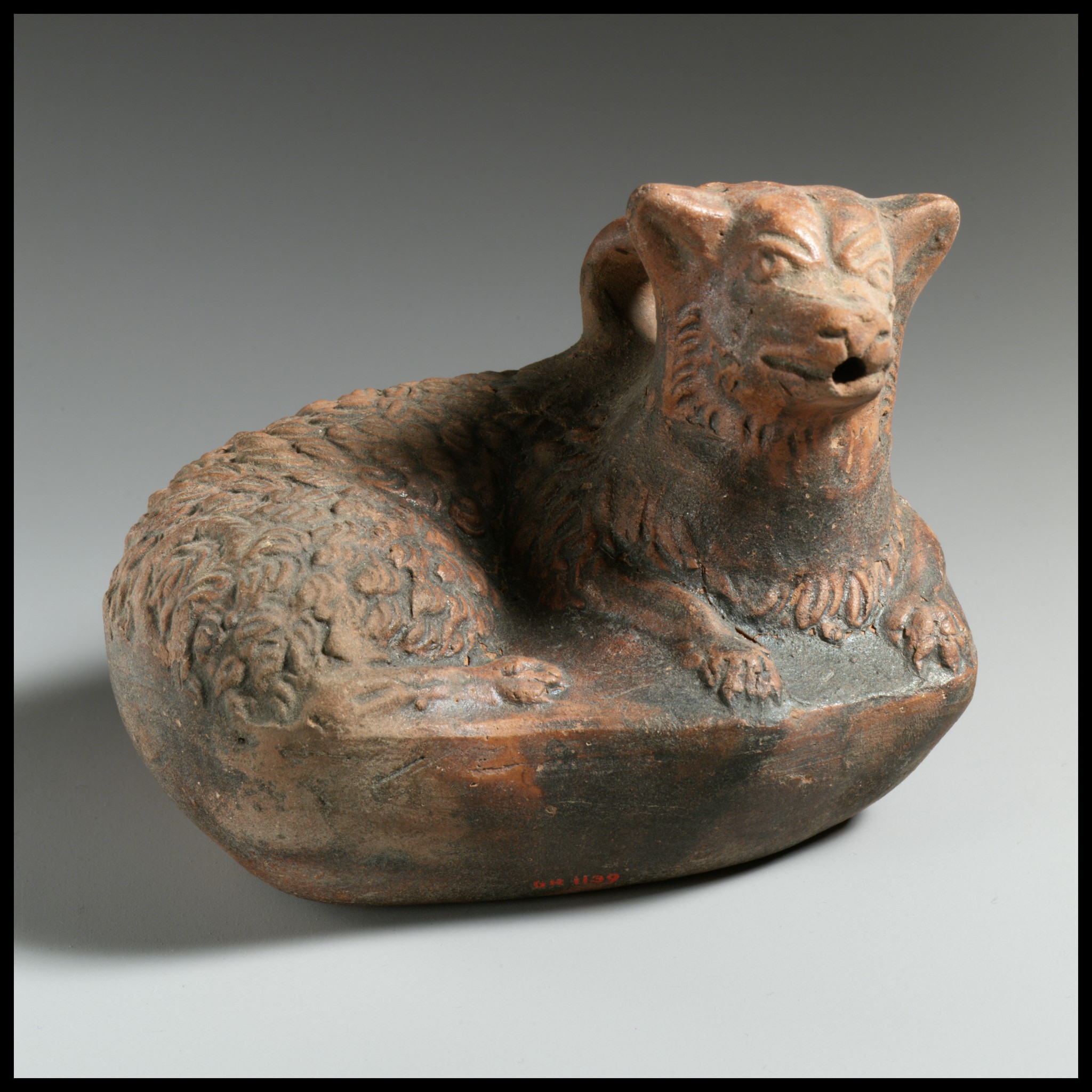
Dogs appear across practical writing, stories, and art. Taken together, these sources show hunters, household animals, familiar figures, and symbols of attachment. There is a silence, too. We hear far less from ordinary handlers and families than from writers with the means to leave books behind.
Dogs in Ancient Rome: Pompeii, Working Dogs, and Private Grief
If you have ever seen the famous Cave canem mosaic from Pompeii, you already know one Roman dog. The Latin warning means “Beware of the dog.”
The image, from the House of the Tragic Poet, shows a chained animal at an entrance. It is direct and effective. A visitor needed little explanation: this household was protected.
Did ancient Romans keep dogs as pets?
Some did, although Roman dogs also worked. Latin agricultural writers, including Columella, distinguished dogs used for guarding property or flocks from those used in hunting. These categories tell us what work mattered to particular landowners, not that every household followed one universal system. [14,19]
The mosaic adds a more urban setting: a dog represented at the threshold of a home. It does not establish that the animal depicted belonged to a modern mastiff or another named breed.
What did archaeologists find in Pompeii?
The most revealing evidence is not always the artwork. Zedda and colleagues studied 113 canine bones and teeth from Pompeii and reported differences in size and form among the animals represented in their archaeological sample. Some findings point toward small-bodied dogs whose likely roles extended beyond the familiar picture of a large guard or hunting dog. [21]
Pompeii was one city, buried by Vesuvius in 79 CE. Its remains offer an extraordinary glimpse—not a complete picture of dogs across the Roman Empire.
Did Romans mourn their dogs?
Inscriptions and epitaphs show that at least some people did. Named dogs such as Margarita and Myia appear in discussions of Greco-Roman memorial writing. These tributes are shaped by literary conventions, but they still preserve the fact that someone chose to commemorate an individual animal. [16]
The epitaphs give a human voice to an otherwise fragmentary record. Roman sources show dogs that worked, dogs displayed as guardians, and dogs whose names someone wanted remembered.
There was no single Roman way of living with dogs.
Dogs in Ancient China: From Ritual Burials to Pottery Companions
The history of dogs in early China challenges the comforting assumption that every ancient relationship with a dog resembled the one many families have today.
During parts of the Shang and Western Zhou periods, some dogs were deliberately killed and placed in human burial contexts. Their presence formed part of ritual practice. That is different from an animal simply being buried after a natural death, and researchers must evaluate specific sites before deciding how a deposit was made. [7]
Why did clay dogs appear in later tombs?
Over time, some mortuary contexts came to include ceramic dog figures rather than the bodies of real dogs. This was not one sudden change across all China. Practices varied across regions and centuries. Kelsey Granger's research examines how the role of dogs in tombs changed and how those shifts might reflect changing ideas about protection, service, and the afterlife. [7]
These pottery dogs remind us that the symbolic role of an animal could continue after real animals were no longer being placed in some tombs.
A Han dynasty dog with a collar
One especially memorable piece is an Eastern Han earthenware dog held by The Metropolitan Museum of Art. The figure wears a detailed collar, a small feature that makes its canine identity instantly familiar. [22]

Its detailed collar gives the figure a familiar quality. At the same time, its funerary setting tells us first about beliefs surrounding the dead.
China's archaeological record includes ritual death, symbolic replacements, working roles, and changing beliefs. It cannot be told as a simple journey toward the modern household pet.
Dogs in Ancient India and South Asia: A History That Needs Careful Reading
Across South Asia, dogs appear in archaeological summaries, art, and long-lived religious and literary traditions. But South Asia is not one culture with a single unchanging view of animals.
Evidence discussed in overviews drawing on Deccan College archaeozoological work points to dog remains and representations across different settlements and periods. A fuller study would need to return to each excavation report: where the bones were found, how they were identified, and whether the dates can be trusted. [23]
What do ancient Indian stories tell us about dogs?
In some epic and religious traditions, dogs are connected with faithfulness, social boundaries, and moral testing. These stories are valuable evidence of ideas. They are not straightforward records of how an ordinary family fed, trained, or bred its dogs.
Even the date of a text can be complicated. Stories may have been told, expanded, or written down across generations. It would be a mistake to place an episode in one archaeological century simply because its setting seems ancient.
Those stories deserve attention on their own terms. The sources reviewed here do not establish a continuous genetic line from any ancient South Asian dog to a modern named breed.
Written traditions can be rich even when evidence about individual animals remains scarce.
Dogs in the Ancient Maya World: What Their Bones Reveal About Travel
Some of the most surprising evidence about ancient dogs comes from chemistry rather than writing or art.
At Ceibal, Guatemala, archaeologist Ashley Sharpe and colleagues analyzed animal remains from contexts spanning roughly 1000 BCE to 950 CE. They studied chemical signatures preserved in bones and teeth, including isotopes related to diet and geographic origin. [24]
Did the Maya move dogs over long distances?
The evidence indicates that at least some dogs were moved from outside the local region. Isotopic signatures from certain animals were consistent with origins beyond Ceibal, including the Guatemalan highlands. Their contexts suggest connections with ceremonial and elite activities. [24]
That finding changes the picture. At least some dogs moved through human networks, perhaps by exchange, deliberate management, or ceremonial arrangements. We cannot tell how each journey happened.
Still, an isotope result does not tell us who carried an animal, what it was called, or whether it had a favored place in someone's home. Researchers must compare chemical data with burial or disposal context to build the strongest explanation.
The Maya evidence also expands the story beyond the Mediterranean. People in different parts of the world managed dogs for reasons shaped by their own communities and beliefs.
What Do We Know About Dogs in the Mexica and Andean Worlds?
A wider history of dogs in the Americas must also address the Mexica (Aztec) world and the many societies of the Andes. These subjects deserve more than a few familiar anecdotes.
The studies assembled for this article do not yet support a detailed, site-by-site account of Mexica or Andean dogs. Rather than invent examples or assign modern breed names to unfamiliar finds, we leave that part of the story open. [25]
Their absence from the detailed comparison is a research boundary, not evidence that dogs were unimportant. A responsible follow-up would require region-specific archaeology, appropriate historical sources, and careful attention to differences among societies.
What Did Ancient People Select Dogs to Do?
Long before a dog could have a modern pedigree certificate, people recognized that dogs were good at different jobs.
Greek hunting texts describe evaluating performance. Roman agricultural writers discuss guarding property and flocks. Egyptian art portrays different body forms in scenes connected with work and ritual. Other societies left evidence of dogs being moved, offered, represented, or placed where their protective meaning mattered. [8,14,15,19,24]
Choosing a useful dog is not the same as controlling breeding for generations. A community could value speed, courage, or a certain size without keeping a managed breeding population in the modern sense.
Archaeologists look for patterns over time: groups of animals with consistent physical traits, traces of movement between populations, written instructions, and ideally ancient DNA. A single fast-looking dog carved on a wall cannot prove that people bred the same type for centuries.
There is another gap in the record. Palaces, shrines, wealthy tombs, and elite writings often survive better than ordinary homes. We know much less about the meals, training, or sleeping places of the dogs that never entered a monument.
Every civilization contained more kinds of canine relationships than its best-known artifacts can show.
Were Ancient Dogs the Same Breeds We Have Today?
Not in the modern kennel-club sense—and appearance alone cannot prove a continuous lineage.
An Egyptian hound in a painting may resemble a Greyhound or Saluki. A large Assyrian dog may remind us of a mastiff. A small dog in Roman remains may look like the kind of companion people keep in apartments today.
Those comparisons can help readers imagine the animals' shapes. They do not establish that a modern breed existed unchanged thousands of years ago.
Modern breeds generally involve documented standards and breeding populations defined by much later institutions. Ancient societies certainly recognized useful differences among dogs, and some may have managed particular populations over long periods. But proving a direct genetic line from one ancient image to a specific modern breed requires evidence we usually do not have.
This matters because historical origin stories can be appealing. A breed described as “the dog of the pharaohs” or “a Roman war dog” sounds impressive. The evidence is often more complicated—and more interesting—than the slogan.
What Remains Unanswered About Ancient Dogs?
By now, the contrast should be clear. Ancient dogs were not only workers, and they were not always treated as beloved companions. They could be useful, admired, feared, sacrificed, commemorated, or represented as protectors long after their bodies were gone.
We can identify some of those relationships with confidence. A Roman inscription shows that someone memorialized a named dog. A Pompeian assemblage reveals dogs with different body sizes. A buried Assyrian figurine belonged to a protective ritual context. Maya isotope measurements point toward the movement of certain animals between regions. [5,16,21,24]
Many everyday questions remain unanswered. How were puppies trained? Which dogs ate well? Did families choose which animals bred, or did they simply keep those that proved useful? And how often did new dogs arrive from other regions?
These are good questions for future archaeology, not invitations to invent answers.
What emerges is a richer history of coexistence. Dogs entered different human worlds and were given different places within them. Some guarded doors. Some accompanied hunters. Some stood at the center of sacred ceremonies. And a few were remembered by name.
Their stories survive unevenly, but enough remains to show that the bond between dogs and humans was never just one thing.
Sources and Archaeological Objects
- Nicholson, P. T. et al. (2015). “The Catacombs of Anubis at North Saqqara.” Antiquity 89(345), 645–661. https://doi.org/10.15184/aqy.2014.53
- Hartley, M. (2015). “The Significance of Predynastic Canid Burials in Ancient Egypt.” Archéo-Nil 25, 57–74. https://researchers.mq.edu.au/en/publications/the-significance-of-predynastic-canid-burials-in-ancient-egypt/
- Hartley, M., Buck, A. & Binder, S. (2011). “Canine Interments in the Teti Cemetery North at Saqqara during the Graeco-Roman Period.” In Abusir and Saqqara in the Year 2010/1. https://researchers.mq.edu.au/en/publications/canine-interments-in-the-teti-cemetery-north-at-saqqara-during-th/
- “Imaging the gods: animal mummies from Tomb 3508, North Saqqara, Egypt.” Antiquity 93(367) (2019), 128–143. https://doi.org/10.15184/aqy.2018.189
- The Metropolitan Museum of Art, “Dog,” Neo-Assyrian bronze from Nimrud, object 323812. https://www.metmuseum.org/art/collection/search/323812
- Nett, S. (2021). “The dogs of the healing goddess Gula in the archaeological and textual record of ancient Mesopotamia.” McDonald Institute for Archaeological Research. https://www.repository.cam.ac.uk/items/e7e56308-2165-44c4-97b3-3cf66300a1b2
- Granger, K. (2023). “From tomb-keeper to tomb-occupant: the changing conceptualisation of dogs in early China.” Journal of the Royal Asiatic Society. https://doi.org/10.1017/S1356186322000529
- The Metropolitan Museum of Art, “Relief fragment with two young dogs,” object 543886. https://www.metmuseum.org/art/collection/search/543886
- The Metropolitan Museum of Art, “Dog,” faience, object 546785. https://www.metmuseum.org/art/collection/search/546785
- The Metropolitan Museum of Art, “Figurine of a Dog,” object 555715. https://www.metmuseum.org/art/collection/search/555715
- Hole, F. & Wyllie, C. (2007). “The Oldest Depictions of Canines and a Possible Early Breed of Dog in Iran.” Paléorient 33(1), 175–185. https://doi.org/10.3406/paleo.2007.5213
- Nikzad, M., Rezaie, I. & Khalili, M. (2020). “Dog Burials in Ancient Iran.” Iranica Antiqua 55, 49–72. https://doi.org/10.2143/IA.55.0.3289191
- Encyclopaedia Iranica, “Dog.” https://www.iranicaonline.org/articles/dog/
- Anderson, J. K. (2015). “Dogs.” Oxford Classical Dictionary. https://doi.org/10.1093/acrefore/9780199381135.013.2265
- Xenophon, Cynegeticus (ancient primary literary source; compare critical editions and translations).
- Fögen, T. (2023). “Death and Emotion: Deceased Dogs in Graeco-Roman Antiquity.” Narodna umjetnost 60(2), 81–99. https://doi.org/10.15176/vol60no205
- The Metropolitan Museum of Art, “Terracotta guttus with a depiction of a dog,” object 255346. https://www.metmuseum.org/art/collection/search/255346
- The Metropolitan Museum of Art, “Terracotta askos in the form of a dog,” object 256597. https://www.metmuseum.org/art/collection/search/256597
- Columella, De re rustica, Book VII (ancient primary agronomic source; compare scholarly editions).
- “Transmission of Zoonotic Diseases in the Daily Life of Ancient Pompeii and Herculaneum.” Animals 12(2), 213 (2022). https://doi.org/10.3390/ani12020213
- Zedda, M. et al. (2006). “Ancient Pompeian dogs—morphological and morphometric evidence for different canine populations.” Anatomia, Histologia, Embryologia. https://pubmed.ncbi.nlm.nih.gov/16968252/
- The Metropolitan Museum of Art, “Figure of a Dog,” Eastern Han, object 42361. https://www.metmuseum.org/art/collection/search/42361
- INDog Project, “Archaeological Record for the Domestic Dog (Canis familiaris) in India” (secondary overview with Deccan College archaeological contributors). https://indog.co.in/archaeological-record-for-the-domestic-dog-canis-familiaris-in-india/
- Sharpe, A. E. et al. (2018). “Earliest isotopic evidence in the Maya region for animal management and long-distance trade at the site of Ceibal, Guatemala.” PNAS 115(14), 3605–3610. https://doi.org/10.1073/pnas.1713880115
- Research limit: No independent primary archaeological study of Mexica or Andean dog practices has yet been sufficiently assessed for specific factual claims in this draft. Section is explicitly a scope note, not a synthesis of verified findings.
Editorial research note: This article interprets archaeological publications and museum records. It does not report an original excavation, constitute a systematic review, or establish a genetic pedigree for modern breeds. Some publications were consulted through abstracts or institutional descriptions rather than full critical editions. Museum object identification and image reproduction rights must be checked separately.
Editorial Note: This article reflects information available at the time of publication or its latest documented review. Scientific knowledge, recommendations, and relevant circumstances may change as new information becomes available.
Research Context: Scientific findings should be interpreted in light of the methods, sample sizes, and limitations of the cited research. Associations do not necessarily establish causation, and results may not apply to every animal or situation.